A 7-Day Coffee Journey in Colombia
Posted by Grace on January 5, 2026
In December 2025, we embarked on a 7-day journey to Bogota, Colombia. As a newly minted coffee aficionado, we were eager to dive deep into coffee tasting and learn about the rich Colombian coffee culture. We absolutely loved it, especially our time in the mountains on coffee farms. We’re excited to share our experience with you.
Contents
- Day 1: Arrival in Bogota. Visited Café Cultor and Café Libertario.
- Day 2: Tropicalia and a Walking Tour of Bogota
- Day 3: Morning Rituals at Amor Perfecto
- Day 4: A Deep Dive into Coffee and a Tasting Menu at Incorrecto Cocina
- Day 5: (I was sick!)
- Day 6: The Great Escape to La Palma y El Tucan
- Day 7: The Paradise of La Palma y El Tucan
Day 1: Arrival in Bogota. Visited Café Cultor and Café Libertario.
Colombia is famous for its coffee, a fact known by coffee lovers worldwide, yet surprisingly few make the trip to see it where it grows. For us, this trip was all about tasting local varieties and understanding the diverse methods of preparation.
Traveling during Christmas can be challenging since most shops are closed, but we were thrilled and grateful to find Café Cultor, a renowned coffee shop, open. The atmosphere was cozy and unhurried.
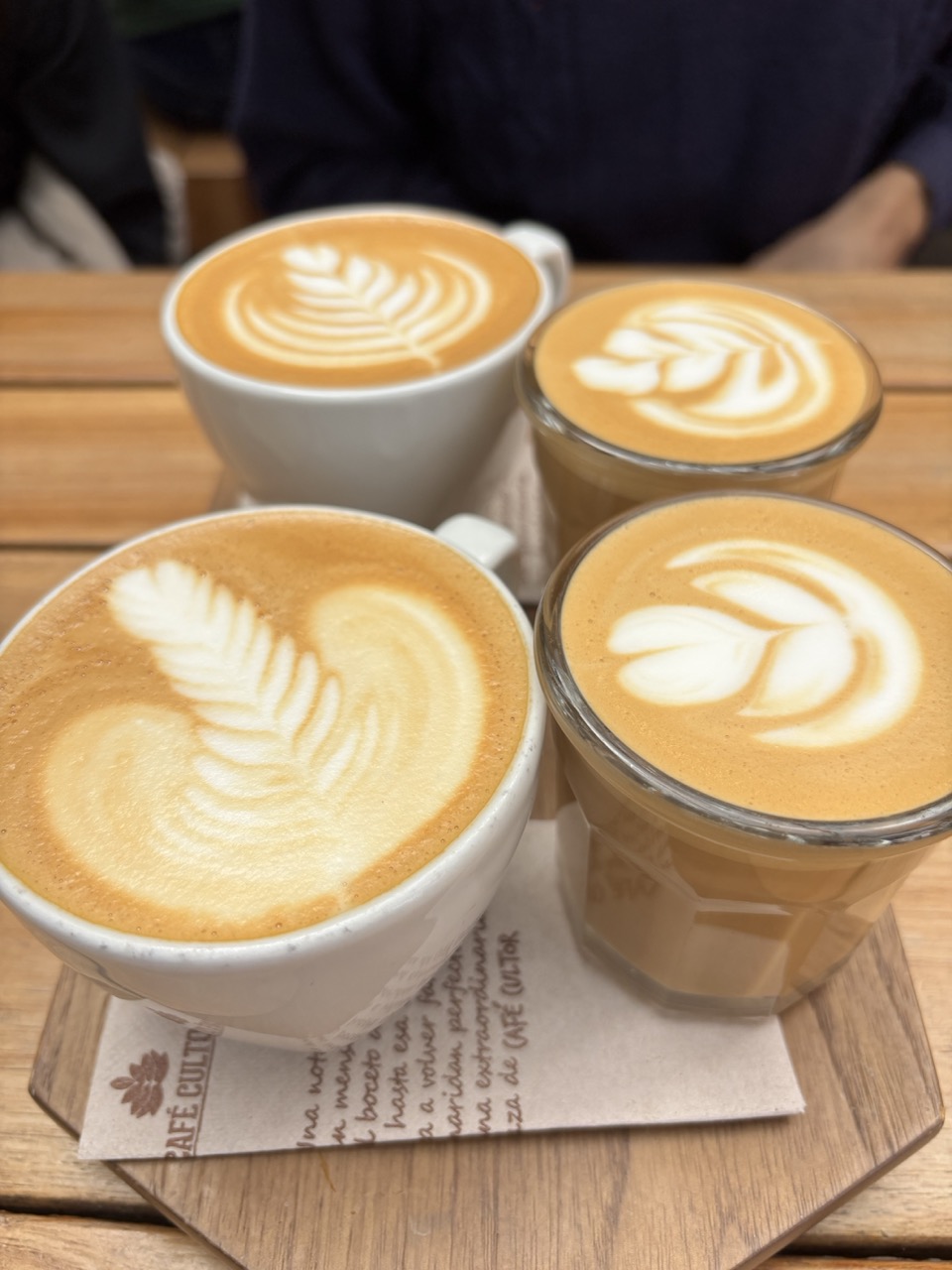 The coffee drinks we got from Café Cultor
We used to think all coffee tasted more or less the same, but now we can instantly distinguish a single origin from a blend. This morning, one sip of a single origin revealed deep, fruity notes (whereas blends often lean toward chocolate and nuts). It makes perfect sense: in a country that produces such world-class coffee, they naturally showcase their own beans rather than blending them with imports.
(Side note: People often ask about Starbucks. To us, Starbucks is the bottom of the barrel. The beans are mediocre, and the craft is lacking. That’s why they specialize in sugary, flavored drinks—to mask the quality of the coffee with syrups and spices.)
Even my two kids have started to love coffee. We used to insist they drink decaf, but they’ve since "upgraded" themselves to regular beans by sneaking sips of ours. The impact on their developing brains and bodies is... well, hard to measure!
After soaking up some midday sun, my husband and I left the kids at the Airbnb to explore more of the city.
We stumbled upon Libertario, a unique shop known for its award-winning beans. While competition-grade beans are only available seasonally, today’s selection was fascinating. It had a distinct sweetness reminiscent of sugarcane.
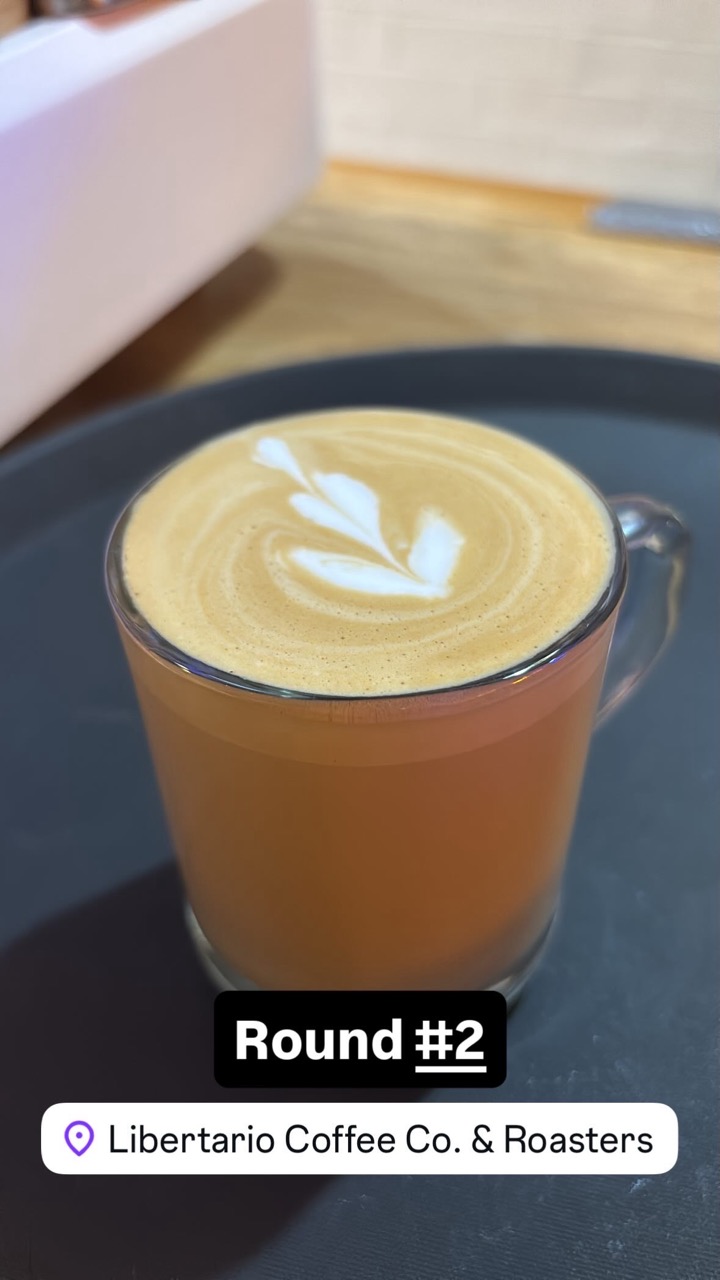 Flat white from Libertario
Sharing a quiet coffee with my husband was pure bliss 😌. While Bogota’s temperature is similar to Dallas, the high altitude and surrounding mountains make it much more humid and lush—perfect for coffee. Sitting under a large tree with a gentle breeze, coffee in hand—there’s truly nothing more relaxing.
Afterward, we headed back, gathered the kids, and went for a sunset hike.
Day 2: Tropicalia and a Walking Tour of Bogota
In the morning, the kids weren't in the mood to go out, so Mac and I headed out solo again! This time, we visited Tropicalia, ranked as the top coffee shop in South America. Mac ordered a pour-over, and I had a latte. To be honest, we were both a little disappointed. So far, the shops we’ve visited have leaned heavily into floral notes, but we haven’t found many that highlight the chocolatey, nutty flavors we love. The search continues!
We went back to prepare lunch: simple pan-seared red trout from the supermarket. It was delicious and definitely made it into my "travel cooking" repertoire. My daughter even made chocolate-covered strawberries for dessert—perfection.
In the afternoon, we stopped briefly at a quirky coffee shop called Arte y Pasion Cafe Presidencial in Bogota’s old town where the baristas do custom latte art based on your request. Unfortunately, we were short on time and had to head to our tour before we could fully enjoy it.
We had booked a three-hour walking tour to learn about Colombian culture—a must-do for us whenever we travel. A good guide adds so much color and context to a city, making the memories stick. In those three hours, we learned about the history of Colombia, as well as our neighbors, Venezuela and Ecuador.
One interesting story: everyone knows Coca-Cola originally contained cocaine. The Coca plant itself has very low concentrations of the alkaloid; locals traditionally used it as a medicinal tonic from nature. However, once it was discovered that cocaine could be extracted and commercialized for profit, it became a source of significant harm.
Our guide also introduced us to some unique local drinks. The most interesting was Chicha, a fermented corn drink. Historically, it involved a rather... "organic" fermentation process (let’s just say it involved saliva 🤢), followed by a month of fermentation. It tastes remarkably like Kombucha—tart, bubbly, and slightly alcoholic.
It’s fascinating how cultures around the world use probiotics to ferment food: yogurt is universal, Korea has Kimchi, Japan has Kombu tea, China has various pickles, and South America has Chicha.
I’ve spent the last year researching bacteria, specifically how processed foods are slowly erasing the beneficial microbes in our systems. I’ll admit I was a little nervous after drinking the Chicha—I hope it plays nice with the gut microbiome I’ve been working so hard to restore and perhaps even adds some healthy diversity!
After six hours of walking, we were ready for a feast. We found an Argentinian steakhouse called 69 Gauchos in Bogota and went all out. The four of us ordered two large steaks, pork chops, and a suckling pig. A massive amount of meat for less than $100. In Dallas, that would have cost three times as much!
Because our dietary habits have changed, our travel strategy has evolved too: we buy the best ingredients to cook at our Airbnb for most meals, and when we do go out, we only seek out the most exceptional or "classic" spots. Mac jokes that I’ve become incredibly picky—I only want to eat at steakhouses or Michelin-starred restaurants 😅. But we love this approach: no mediocre meals, only the classics!
Day 3: Morning Rituals at Amor Perfecto
My husband and I started the morning just like we would in Dallas: a workout followed by coffee, just in a different setting.
Today we tried Amor Perfecto, another legendary spot.
What struck us first was their espresso machine: it was split into three separate stations based on function, whereas traditional machines are usually a single, massive unit.
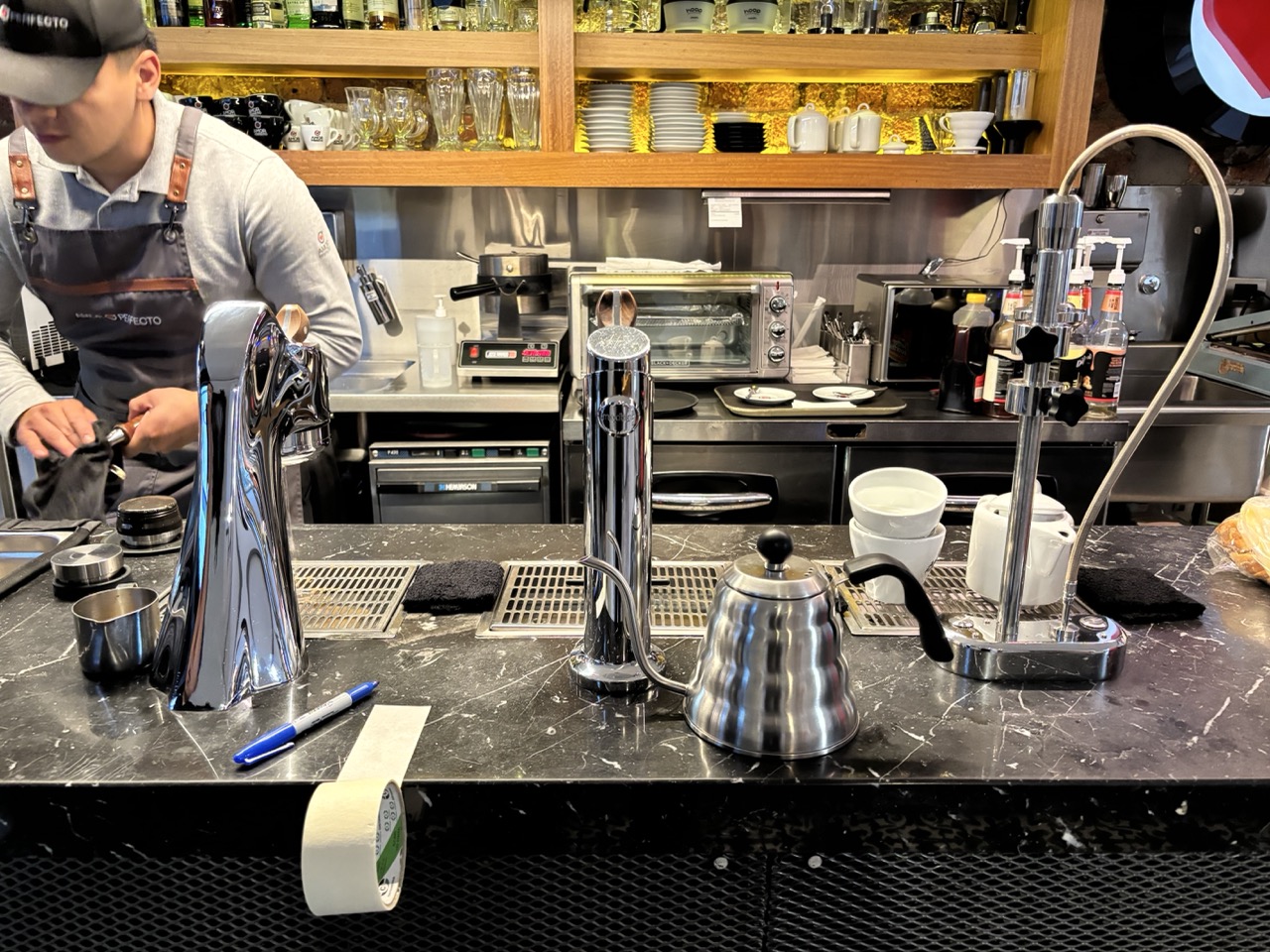 The machines at Amor Perfecto
We also noticed their meticulous process—they never just grab a random cup; every cup is pre-heated before the coffee touches it.
The shop also houses a coffee lab, where we saw people testing how different water qualities affect the final brew.
The baristas in Bogota are incredibly skilled; they can casually pour a perfect swan 🦢 into your latte while carrying on a conversation.
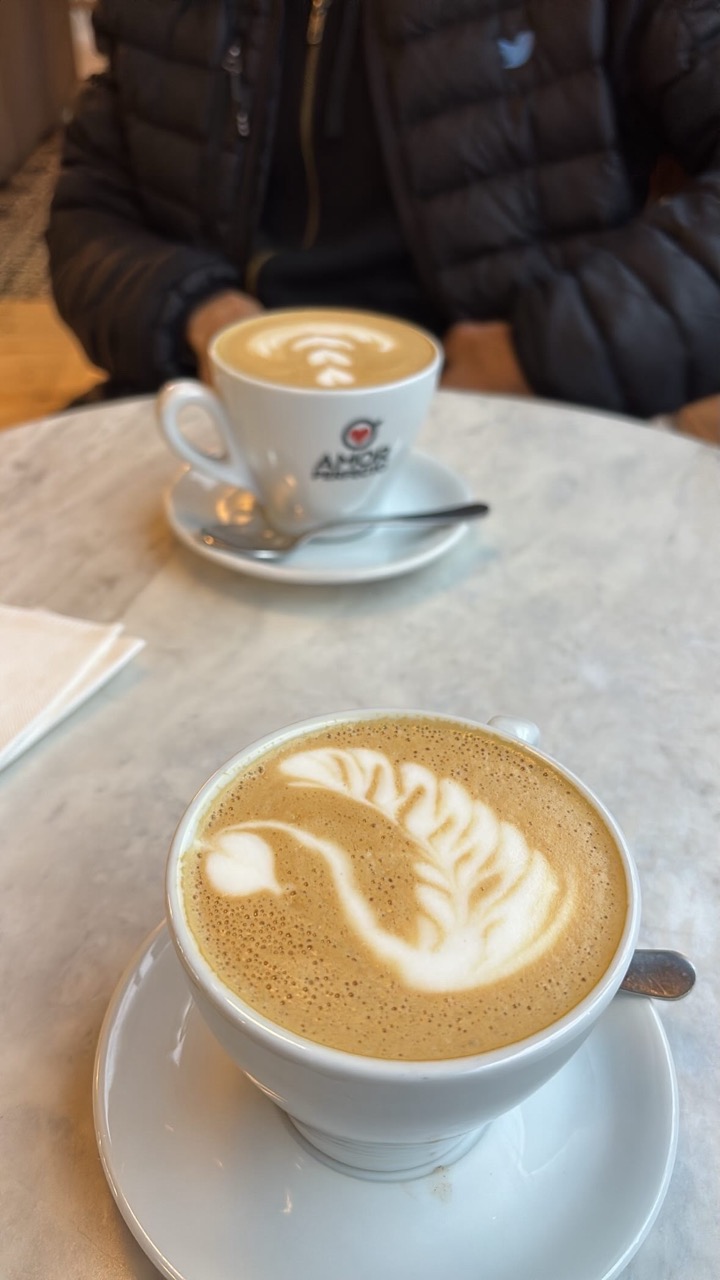 Drinks from Amor Perfecto
As for the flavor—we finally found it! A nutty blend that has won numerous awards. it reminded us of the "Woolloomooloo" blend from Toby’s Estate in Sydney.
Bogota’s weather is so mild and temperate that my skin has actually improved. The vegetation is incredibly lush; everything is green, and it feels so rejuvenating.
Colombia remains a relatively niche destination for tourists, and almost no one speaks English. In our tour group yesterday, we were the only Americans; everyone else was from South America or Europe. Interestingly, the Canadian government recently issued a travel advisory for Colombia. It makes me wonder about the country’s evolving role on the global stage.
Day 4: A Deep Dive into Coffee and a Tasting Menu at Incorrecto Cocina
The Night of No Sleep 😭
Last night took my impression of Colombia down a few pegs. Do people here ever sleep? From midnight until the early hours, cars were driving by with loudspeakers blasting music at full volume—one after another, for hours on end. I barely slept a wink.
I value my sleep immensely, so this was incredibly frustrating. I spent half the night just lying there, feeling annoyed at the whole country. 😅
It’s a stark reminder of cultural differences. South American countries are so vibrant and "hot-blooded"—I felt the same in Brazil. I can’t imagine people in Japan, for instance, being so indifferent to their neighbors' peace and quiet in the middle of the night.
A bad night’s sleep definitely casts a shadow over the next day.
The Coffee Masterclass ☕️
My husband booked a coffee experience for us. A professional barista guided us through a tasting, teaching us how to use our palates to identify different tasting notes.
I learned that coffee from different regions of Colombia has entirely different flavor profiles. From now on, I can probably guess the flavor just by looking at the origin. I personally love nutty notes, which typically come from Northern Colombia.
I also realized how incredible our tongues are. Different parts of the tongue—the tip, the middle, the sides, and the back—perceive flavors differently.
During the session, I discovered that I perceive jam, chocolate, peanuts, and almonds at very specific, different locations on my tongue. And it’s different for everyone!
Next time you eat, try to notice where on your tongue the flavor hits first and strongest.
I also learned something new: the specific flavor profile isn’t directly caused by the surrounding vegetation (as I previously thought). It’s actually determined by the climate and elevation.
We also experimented with several brewing methods:
- Siphon: A Japanese invention that looks like a chemistry experiment.
- Chemex: Uses thick filters that remove most impurities, leaving a very clean cup with almost no aftertaste.
- AeroPress: Invented in 2005 by a Stanford lecturer. Our barista said it’s her favorite: it’s portable, durable, and allows you to taste every dimension of the coffee.
We also explored how different processing methods change the flavor:
- Natural (Sun-dried): More complex and "funky."
- Honey Process: More pronounced sweetness.
- Washed: A different, cleaner clarity.
I curiously asked the barista: How many cups do you drink a day? And at what age do kids here start drinking coffee?
She said people in the industry drink at least two cups a day, often more, and the caffeine has zero effect on their sleep. As for the kids—they start very young. It’s just the culture!
Bogota might not be the most modern or polished city, but the people in the coffee industry are incredibly dedicated and passionate. Coffee isn't just a drink here; it’s their lifeblood.
A Colombian Tasting Menu 🍽️
As I mentioned before: no mediocre meals. Today, we went for something truly special.
We visited a Colombian restaurant called Incorrecto Cocina. Everything is made fresh using local ingredients. We ordered a seven-course tasting menu.
Every single dish was spectacular. My top three favorites were:
- Pig’s Trotter: Perfectly soft and crispy.
- Beef Tongue: Incredibly flavorful.
- Sweet Rice Pudding: A flavor I’ve never experienced before.
The meal was also a huge inspiration for my own cooking. My primary carb sources these days are pumpkin, potatoes, and sweet potatoes—whole, natural foods with a balanced mix of carbs, fiber, and micronutrients.
During this trip, I’ve noticed they use a lot of Yuca and Plantain as staples, which has given me so many new ideas 💡!
And once again—this entire seven-course tasting menu was less than $50 per person.
Day 5: (I was sick!)
I was sick the whole day. My nose was running, my eyes were stinging, and my throat was sore. I had a fever of 37.4°C (99.3°F).
Day 6: The Great Escape to La Palma y El Tucan
Bogota is a noisy, polluted city. I felt like I was coming down with something; my sneezes felt like mini-earthquakes, and everyone else’s eyes were stinging from the smog.
After three hours of winding mountain roads, we finally reached the deep forest. No Wi-Fi, no motorcycle engines, no loud music. Just the sound of birds—countless varieties of them!
While in Colombia, I heard an interesting perspective: Humans and nature are meant to coexist, but over time, humans have come to believe they own nature.
Through my health research this past year, I’ve learned that humans and nature are perfectly intertwined. Trees turn CO2 into oxygen through photosynthesis, and our lungs turn oxygen back into CO2. I knew the science, of course, but I had never felt the weight of that connection until now.
Scientific research increasingly shows that being in nature significantly lowers stress hormones, and certain substances secreted by trees can directly benefit human health. I believe there is still so much more left for us to discover.
We had a great dinner at the farm. All ingredients were fresh and locally sourced.
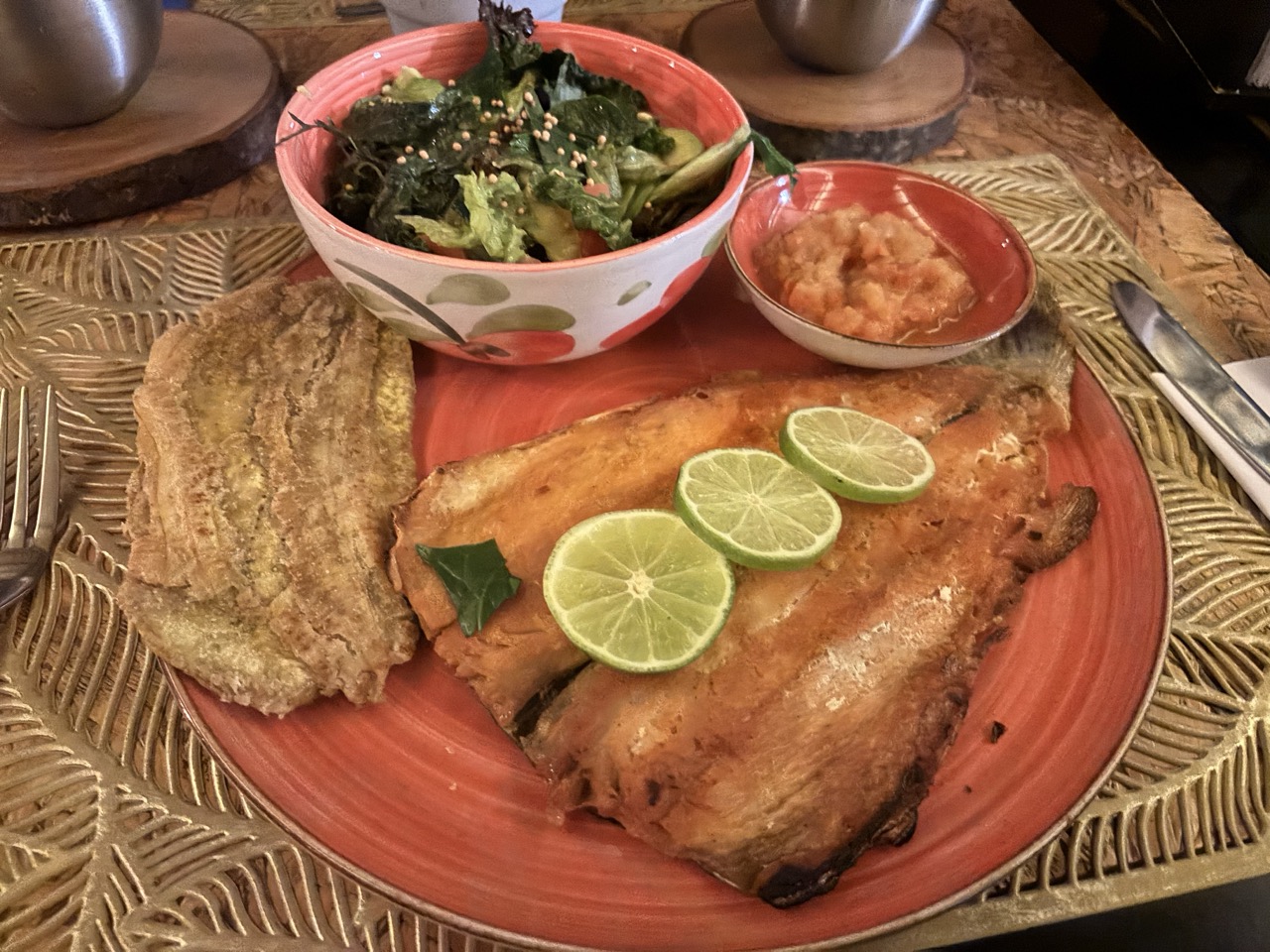 Meal at the farm: plantains, trout and greens from the garden.
Day 7: The Paradise of La Palma y El Tucan
Sleeping in a log cabin in the forest was a surreal experience. With no city lights and no urban noise, the darkness was absolute, filled only with the chorus of insects and birds. The four of us shared one room and slept more soundly than we have in years—a full ten hours of deep rest.
Breakfast was prepared by local residents using fresh, homegrown ingredients. Afterward, we embarked on a three-hour hike through the coffee plantation.
Ten years ago, this land was a cattle ranch. A coffee expert recognized the potential of the terrain and climate, bought the farm, and transformed it into a plantation.
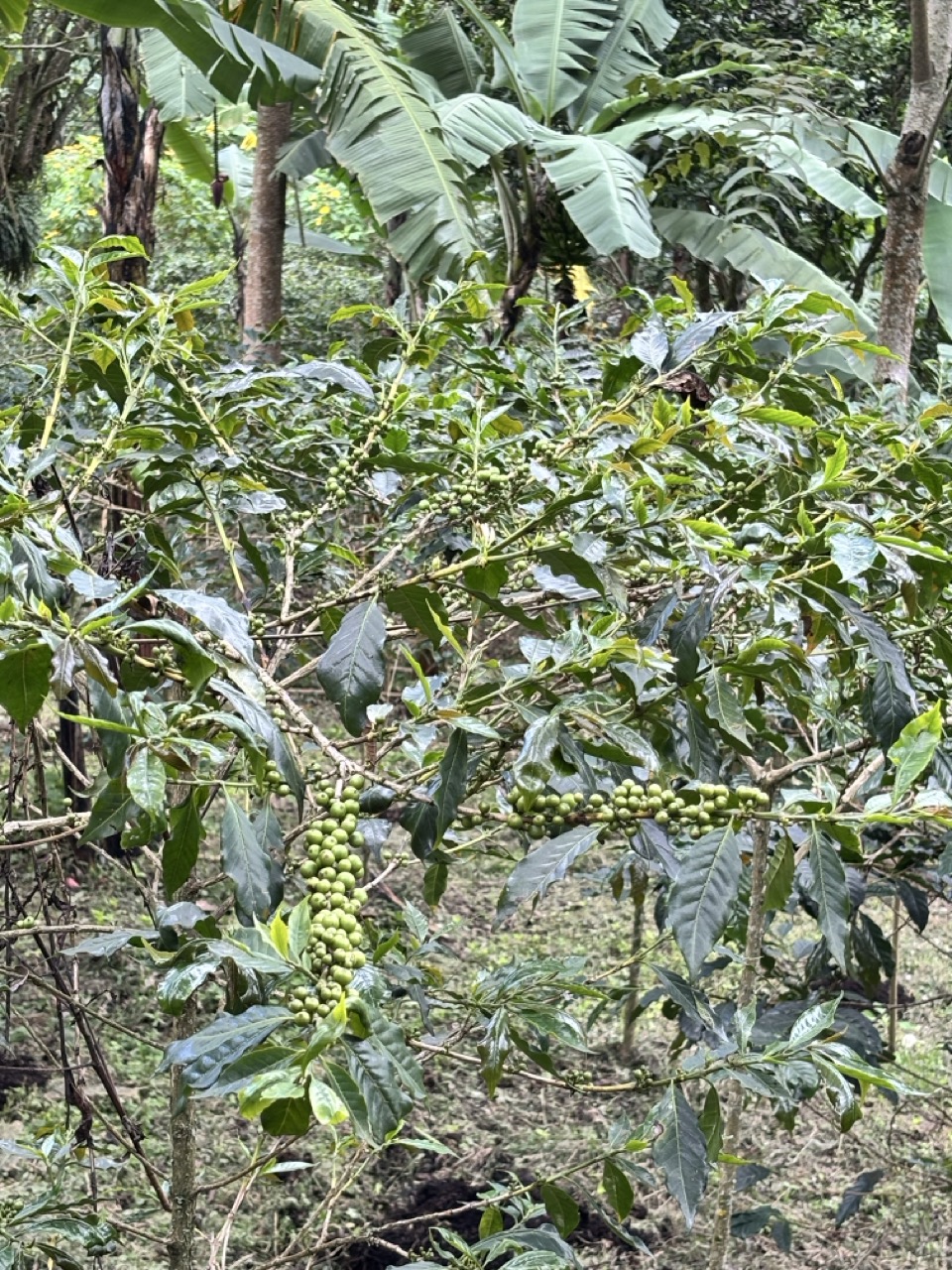 The plantation at La Palma y El Tucan
Their farming method is fascinating—it’s not a monoculture. They intersperse coffee trees with bananas, avocados, and countless other plants. This provides shade, aids pollination, and fixes nitrogen in the soil.
Along the way, our guide picked a few bananas for us. The taste was unlike anything you’d find in a supermarket—indescribably better.
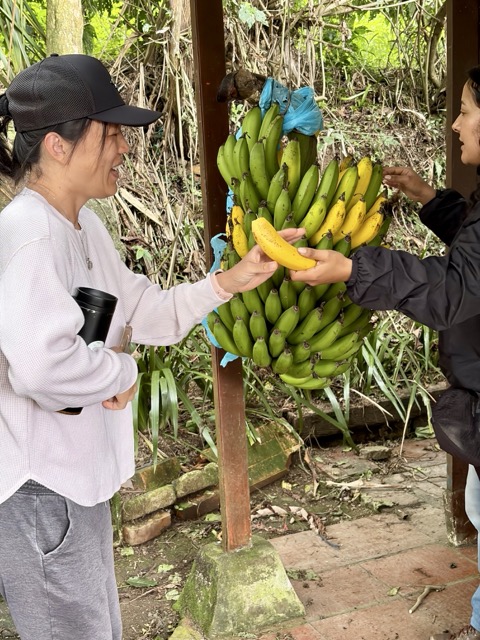 The fresh picked banana is so much better than the ones in the supermarket.
We saw the entire journey from bean to brew and learned about various processing techniques. We then had a tasting session to refine our palates. The highlight was tasting an award-winning, extremely rare bean that sells for $300 a bag!
This is, without a doubt, the most beautiful place I have ever been. It felt like a hidden paradise. I could honestly live here forever.
The drive back was another three hours of bumpy, winding roads. As we jolted along, staring out at the emerald green slopes, the happy cows, and the stray dogs, I found myself thinking of my childhood in Beijing. The roads were uneven back then too, and I remember the constant bumping on my bicycle, always wishing for paved asphalt. Eventually, the roads were paved, but the fields vanished, the ponds were filled, and the dragonflies, wildflowers, and simple joys disappeared with them.
In the evening, we had to say goodbye to the most beautiful place I had ever been and fly back to the US.